


SMS vs Email Marketing: What Works For Shopify Stores

SMS gets a 98% open rate (Omnisend Blog, 2025). Email generates the highest ROI of any marketing channel. Both stats are true — and both get used selectively to declare one channel the winner.
The real question for Shopify merchants isn't which channel is better. It's understanding what each one is actually good at, where each one falls short, and when running both together makes more sense than choosing. Platforms like Omnisend are built around both channels for exactly this reason — the data consistently shows that the combination outperforms either one alone.

The Numbers Side by Side
Before getting into strategy, here's what the performance data actually shows across the metrics that matter for ecommerce decision-making:
| Metric | SMS | |
|---|---|---|
| Open rate | 32–43% | ~98% |
| Click-through rate | 2–2.6% | 10–19% |
| Average response time | Hours to days | ~90 seconds |
| ROI per $1 spent | $10–$36 | $21–$71 |
| Automated revenue per send | $0.15 | $0.74 |
| Cost per message | Fractions of a cent | $0.01–$0.05 |
| Sources: MailerLite Email Benchmarks 2025; Omnisend SMS Marketing Statistics; Marketing LTB SMS Stats 2025 | ||
SMS wins on speed and engagement. Email wins on content depth, list size, and cost at scale. The mistake most merchants make is treating these as competing channels — they're not. They're built for different moments in the customer journey.
What Email Does that SMS Cannot
Email is the only channel that gives you unlimited space to tell a story. Images, multiple links, GIFs, product grids, long-form copy — none of that is possible in a 160-character text message. That content capacity is what makes email the right tool for building the kind of brand familiarity that leads to repeat purchases.
The use cases where email consistently outperforms SMS:
- Welcome sequences — Omnisend data shows welcome email flows convert at 7.7% (Omnisend, 2025), making them the highest-converting automation type. A welcome SMS can support this, but can't replace a multi-email sequence that introduces the brand properly.
- Product launches — new arrivals, lookbooks, or collection releases need visuals and context that email handles naturally
- Post-purchase nurture — review requests, cross-sell recommendations, loyalty program onboarding, and repeat purchase campaigns all work better with email's formatting flexibility
- Educational content — buying guides, how-to content, and brand storytelling require length that SMS simply doesn't allow
- List building at scale — email opt-in rates average 1.95% across industries (ReadyCloud); phone number collection is harder and slower because subscribers treat it as a more personal channel
What SMS Does that Email Cannot
The 98% open rate of SMS isn't a trick of measurement — it reflects something real about how people treat text messages differently from email. An unread SMS creates psychological friction in a way that a promotional email folder never does. That immediacy is the channel's core advantage, and it only works when used for the right type of message.
SMS earns its place in these specific scenarios:
- Flash sales and time-limited offers — according to Omnisend, 58% of customers read SMS immediately. If the window is 4 hours, email often arrives too late to act on
- Abandoned cart recovery — automated cart SMS earns between $3.07 and $10.78 per message sent (Omnisend), among the highest revenue-per-send of any automation type
- Shipping and delivery updates — 67% of consumers prefer delivery notifications via text over email (Tabular), because they check SMS faster
- Back-in-stock and price drop alerts — high-intent moments where the customer has already signaled interest and speed matters
- Last-chance follow-ups — a short SMS after an email that went unopened can recover a sale that would otherwise be lost
The pattern is clear: SMS works best when urgency is the point. If the message can wait until tomorrow, email is the better fit. If it can't, SMS is.
Why Combining Both Channels Changes the Results
The most direct data point on this comes from Omnisend's own platform research: according to Omnisend's platform data, customers who received both email and SMS had a 126.9% higher conversion rate than those who received email alone. That's not a marginal improvement — it's more than double.
The combination works because each channel patches the other's weakness. Email misses customers who don't open in time. SMS misses customers who need more context before deciding. Together, they cover the full range of customer behavior.
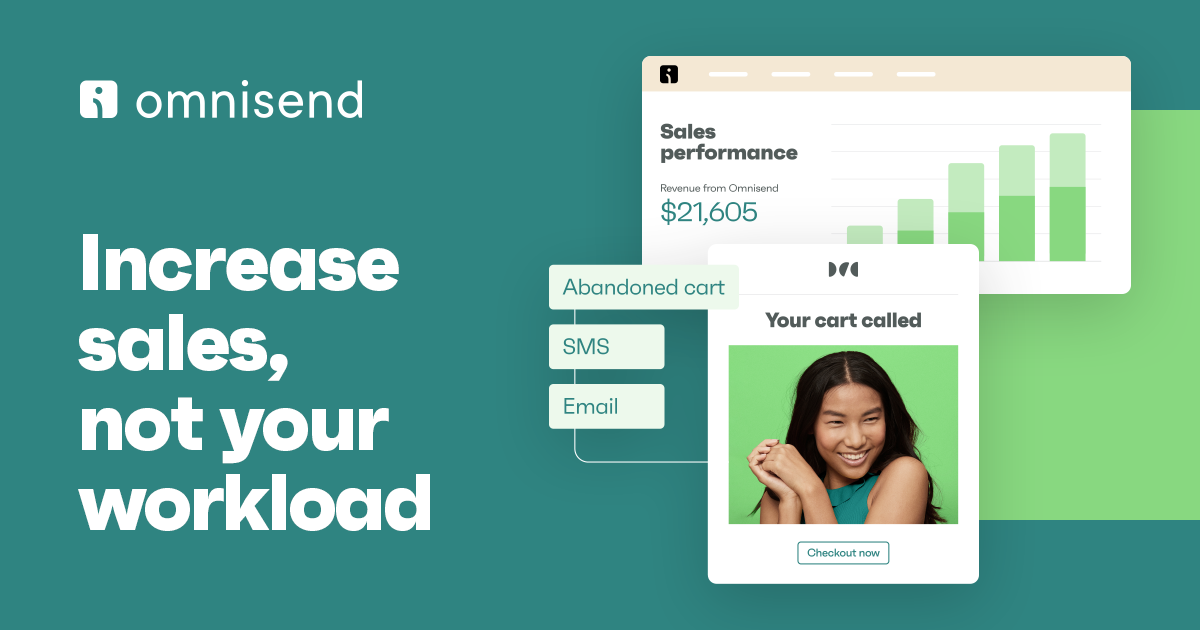
Here's how a combined abandoned cart flow actually looks in practice:
- 30 minutes after abandonment: email with cart contents, product images, and full brand context
- 2 hours later, if email unopened: SMS with a short message and direct checkout link
- 24 hours later, if still no conversion: email follow-up with a small incentive — free shipping or a discount code
Each message does a different job. The email handles depth and brand trust. The SMS handles urgency. Neither step is redundant because they're reaching the customer in different ways at different moments.
The Cost Reality
SMS costs more per message — that's a real constraint, not a reason to avoid it. The question is whether the higher per-message cost is justified by better performance at the moments you're using it for.
The right metric to track isn't cost-per-send. It's cost-per-order. A $0.05 SMS that converts at 3% costs $1.67 to generate one order. An email costing $0.001 that converts at 0.3% costs $0.33 per order — better on paper, but email often can't deliver the urgency needed for time-sensitive offers in the first place. (Source: Omnisend)
Two checkpoints before adding SMS to your stack:
- List quality over list size — a small, opted-in SMS list of engaged buyers will outperform a large one built through incentive-only tactics. Focus on collecting phone numbers from customers who've already purchased before pushing acquisition opt-ins hard.
- Frequency discipline — subscribers tolerate 1–2 SMS per week before opt-out rates climb meaningfully (Omnisend). Email inboxes absorb higher frequency because that's expected behavior. SMS feels more personal, so over-sending damages the channel faster.
How to Start if You're Only Using One Channel
Most Shopify merchants running "email marketing" are actually running one welcome flow, occasional campaigns, and not much else. SMS rarely enters the picture until the store is already scaling. That sequencing makes sense — but it also means many stores are leaving their highest-ROI SMS automations unbuilt.
A practical starting checklist:
- Get email foundations in place first — welcome series, abandoned cart, post-purchase flow
- Add SMS for abandoned cart recovery before any other SMS automation — it's the fastest path to positive ROI
- Layer in SMS for your next flash sale or time-limited promotion and compare performance against email-only results
- Track SMS cost-per-order separately from email for the first 60 days before expanding to more flows
- Cap SMS frequency at 2 sends per week until you have 90 days of opt-out data
Final Thoughts
SMS and email aren't in competition — they're built for different jobs in the same customer journey. The open rate advantage of SMS is real. The depth and scale advantage of email is real. The merchants seeing the strongest results from both aren't choosing between them; they're using each one for the moments it was designed for.
Start with email to build the foundation. Add SMS at the high-intent touchpoints — cart recovery, flash sales, delivery updates — where speed matters more than content. Measure cost-per-order for both. Expand what's working.
Growing your Shopify store's revenue through Omnisend becomes more predictable when both channels are running together — email handling the relationship, SMS handling the urgency, and automation doing the work of timing them correctly.
FAQ
Is SMS worth adding if my email list is already performing well?
Yes. Stores using both channels see up to 126.9% higher conversion rates than email alone. Start with abandoned cart SMS only — it's the fastest way to see positive ROI without disrupting your existing email setup.
How often should I send SMS to Shopify customers?
1–2 times per week is the safe ceiling. Beyond that, opt-out rates climb quickly. Relevance matters more than frequency — a well-timed back-in-stock alert is always welcome; a third promo text in one week is not.
What's the best first SMS automation to set up?
Abandoned cart. It targets customers who already showed purchase intent, earns $3–$10 per message sent on average, and requires no changes to your existing email flows to add.
Does SMS cost significantly more than email at scale?
Per message, yes — $0.01–$0.05 vs fractions of a cent for email. But for time-sensitive campaigns, SMS converts faster and at higher rates, which often makes the cost-per-order comparable or better for the right use cases.


