


Turn Clicks into Clients: How Leadpages Converts Traffic into Revenue

Most businesses don’t have a traffic problem. They have a conversion problem.
You can post daily on social. You can run ads. You can even rank on Google for a few keywords. But if those clicks land on the wrong page—usually a homepage built for browsing, not buying—your traffic turns into vanity metrics instead of revenue.
That’s why landing pages matter. A good landing page doesn’t “look nice.” It moves people from curiosity to action: booking a call, joining a webinar, downloading a lead magnet, or starting a purchase journey. In this guide, we’ll break down why clicks don’t automatically become clients, what makes landing pages different, the five elements that improve conversion, and how Leadpages helps you build conversion-focused pages without needing a developer.
Why Clicks Don’t Automatically Become Clients
Traffic is easy to celebrate because it feels like progress. More views, more sessions, more clicks. But traffic is not the business outcome. Clients are.
Here are the most common reasons clicks fail to convert into paying customers:
Traffic ≠ revenue
Traffic is only a potential revenue input. Without a clear next step, visitors will do what most people do online: skim, scroll, and leave.
Social traffic often arrives cold
Most social visitors are not actively shopping. They’re browsing. If your page doesn’t quickly explain the value and guide them to one simple action, they bounce within seconds.
Your homepage is usually not designed for conversion
A homepage tries to do everything: explain the brand, show products, link to pages, tell your story, and serve many audiences. That makes it a poor conversion tool for specific offers. The visitor doesn’t know what to do next—and confusion kills conversion.
Too many distractions
Navigation menus, multiple links, and “choose your own adventure” experiences work for brand browsing. They don’t work for lead generation. Every extra option is an exit opportunity.
No focused landing pages
The biggest reason clicks don’t become clients is simple: the traffic isn’t landing on a page built for a single conversion goal. Without focused landing pages, you’re paying for attention and then wasting it.
If you want more clients without needing more traffic, the solution is usually not “more ads.” It’s a better conversion bridge.
The Real Difference Between a Website and a Landing Page
A website and a landing page are not the same thing—even if they look similar. They serve different jobs.
| Website | Landing Page |
|---|---|
| Many links and multiple paths | One goal (opt-in, booking, purchase) |
| Full navigation and menus | Minimal distractions |
| Brand storytelling focus | Conversion focus |
| General audience | Specific audience + specific offer |
| Exploration encouraged | Decision encouraged |
Landing pages are not “extra pages.” They’re strategic pages built for a single action. That’s why they convert better: they reduce friction and increase clarity.
And importantly: this isn’t hype. It’s behavior. People convert when they know what to do and why it benefits them.
The 5 Elements That Turn Visitors into Clients
You don’t need fancy design to build a high-converting landing page. You need the right elements in the right order.

1) A clear headline that matches intent
The headline is your first conversion moment. It should answer: “What is this, and why should I care?” Good headlines are specific:
- who it’s for
- what outcome it delivers
- how fast or how easily it works (when truthful)
2) A specific benefit (not generic promises)
“Grow your business” is vague. “Get 10 qualified leads per week from a simple webinar funnel” is specific. Visitors need a concrete result to believe the page is relevant.
3) Social proof that reduces skepticism
Social proof is the shortcut to trust. It can be:
- testimonials
- case study snippets
- logos (if relevant)
- numbers (results, community size, bookings)
The key is authenticity: proof should feel real, not exaggerated.
4) A lead capture form with minimal friction
Every extra field reduces conversions. If your goal is lead generation, keep the form simple. Often, name + email is enough. You can collect more details later through the follow-up sequence.
5) A strong CTA that tells people exactly what happens next
“Submit” is weak. Strong CTAs feel like the next step:
- “Get the free guide”
- “Book a free consultation”
- “Save my seat”
- “Send me the checklist”
When these five elements work together, your landing page becomes a conversion machine—not because it’s persuasive, but because it’s clear.
How Leadpages Makes This Simple
Most people don’t fail at landing pages because they don’t understand marketing. They fail because building pages feels technical, slow, and messy—especially when you need to test multiple offers quickly.
Leadpages is designed to remove that friction with a landing page builder that focuses on speed, simplicity, and conversion structure.
Drag-and-drop builder
You can build and publish pages without code. That matters because conversion improves through iteration, and iteration is impossible if every page requires a developer.
Conversion-tested templates
Starting from a blank page is where many people get stuck. Templates help you start with proven structure: clear hero section, benefit blocks, proof, and CTA placement.
Built-in lead capture
Lead generation is not just design—it’s the form and the follow-up. Leadpages makes lead capture a central part of the build experience so you can connect traffic to email list growth.
Integrations with email tools
The landing page is only step one. The real revenue comes from nurturing. Integrations help you move leads into your email tool so you can follow up automatically.
Mobile optimization
Most traffic is mobile. If a landing page is hard to read on a phone, conversion drops. Leadpages pages are designed to work well across devices so mobile traffic doesn’t leak.
The practical benefit is speed: you can launch offers faster, test ideas faster, and improve conversions without overengineering your website.
Use Cases That Actually Generate Revenue
Landing pages work best when they support a clear offer. Here are four use cases that consistently produce real business results.
1) Webinar registration
Webinars are high-converting because they allow you to teach, build trust, and sell after value is delivered. A good webinar landing page focuses on:
- what the attendee will learn
- who it’s for
- proof and speaker credibility
- one clear registration action
2) Free ebook or checklist funnel
Lead magnets still work when they solve a specific problem. The best lead magnets are not “general guides.” They’re tools: templates, scripts, checklists, frameworks.
Landing page goal: make the lead magnet feel instantly useful so the visitor exchanges an email willingly.
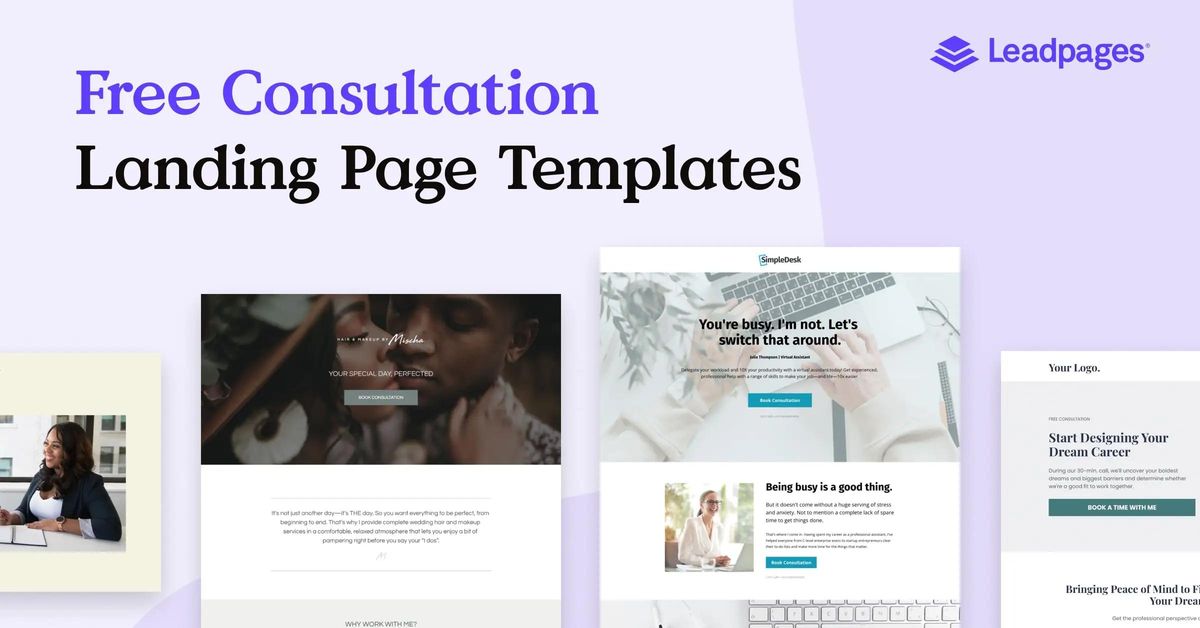
3) Coaching consultation booking
Service businesses often struggle because their website is informational, not conversion-driven. A consultation landing page should:
- clarify who the offer is for (and who it isn’t for)
- show outcomes
- include social proof
- reduce friction to booking
4) Product pre-launch
Pre-launch pages turn interest into a waiting list. That list becomes your highest-intent audience when you open sales. A strong pre-launch page focuses on:
- the promise of the product
- what makes it different
- early access incentive (optional)
- a simple opt-in
These use cases share the same theme: one page, one promise, one action.
From Click to Client: A Simple Funnel Example
Here’s a simple funnel that turns clicks into clients without needing a complex tech stack:
- Traffic (social, ads, SEO, partnerships)
- Landing Page (one offer, one CTA)
- Email Capture (lead magnet or registration)
- Nurture (3–7 emails that educate + build trust)
- Offer (consultation, course, product, service)
Why this works
Traffic is rented attention. The moment you stop posting or spending, it disappears. The email list is owned. It gives you the ability to follow up, build trust over time, and convert people when they’re ready.
Where landing pages fit
Landing pages are the conversion bridge between rented attention and owned audience. Without that bridge, your website becomes a leaky bucket: visitors arrive, browse, and leave with no next step.
This is why tools like Leadpages matter. They help you build that bridge quickly, so you can stop wasting clicks and start capturing intent.
Final Thoughts
Clicks don’t automatically become clients. They become clients when you give people a focused path: one offer, one page, one action—supported by clear messaging and trust signals.
Traffic is rented. Your email list is owned. Landing pages are the bridge that turns attention into revenue.
Building a click-to-client funnel with Leadpages becomes much easier when you start from conversion-tested templates, launch pages fast with drag-and-drop, capture leads seamlessly, and nurture your audience with consistent follow-up—so every click has a clear chance to become a client.


