


How To Build A Global Team Without A Dedicated HR Team

Most companies assume that hiring internationally requires an HR department to manage the complexity — contracts in multiple jurisdictions, payroll across currencies, tax filings in countries they've never operated in. That assumption stops a lot of small teams from accessing the best talent available.
The reality is different. The infrastructure for building a compliant global team without in-house HR expertise now exists in a form that founders, operations leads, and finance teams can manage directly. Platforms like Deel have consolidated what used to require a local entity, a local law firm, and a local payroll provider in each country into a single workflow. The result is that a two-person ops team can do what used to require five HR headcount — if they understand the structure.
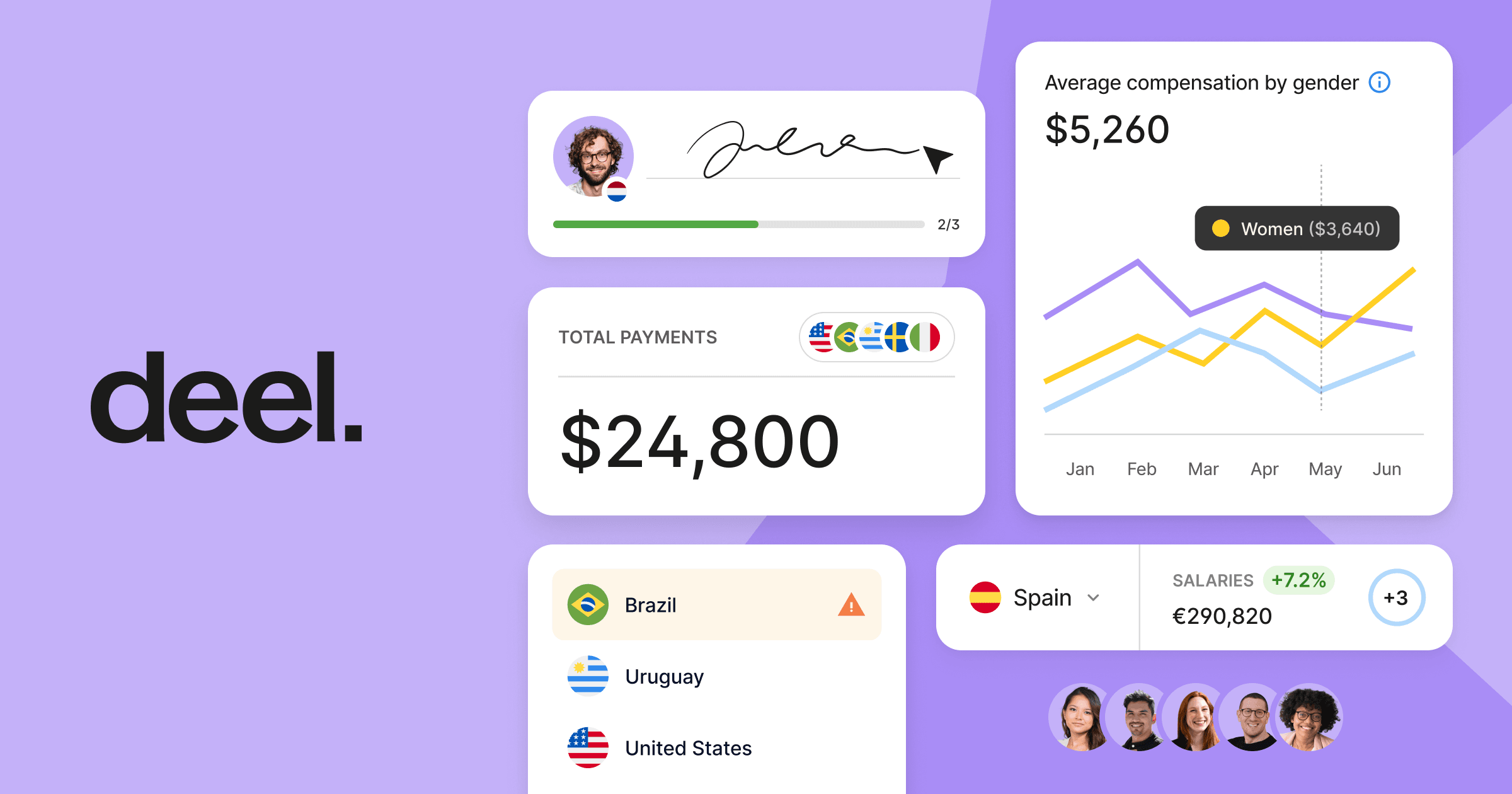
The Two Models for Global Hiring
Before building infrastructure, the first decision is structural: are you hiring full-time employees or contractors? The answer determines which legal and compliance obligations apply, which costs you'll carry, and how much operational overhead each hire generates.
| Model | Best For | Compliance burden | Cost range |
|---|---|---|---|
| Contractor | Project work, flexible scope, testing a new market | Low — contract + payment only | $49/month per contractor (Deel) |
| Employer of Record (EOR) | Full-time employees in countries where you lack an entity | High — handled by EOR provider | $599/month per employee (Deel) |
| Direct employment | High-volume hiring in a single country where you have an entity | Full — requires local legal setup | Entity setup cost + local payroll |
| Source: Deel pricing; Arc.dev EOR services comparison 2025 | |||
For most small teams hiring globally for the first time, the contractor model handles the majority of cases. EOR becomes relevant when a specific role requires employment status — usually for benefits eligibility, visa sponsorship, or roles in countries that restrict contractor classification for long-term work.
When To Use Contractors vs. Full-Time Employees
Misclassification — treating someone as a contractor when local law would classify them as an employee — is the most common compliance risk in international hiring. Penalties vary by country but can include back payment of benefits, social contributions, and fines. In some markets, misclassification triggers automatic reclassification regardless of contract language.
The practical indicators that a role should be employment rather than contractor:
- Exclusive or near-exclusive work for one company. A contractor who works only for you, on a fixed schedule, using your equipment, is likely to be reclassified as an employee in most European and Latin American jurisdictions regardless of what the contract says.
- Integration into the company's core workflow. If the person attends company meetings, uses internal tools, and is managed by a company supervisor, local labor authorities in many countries treat that as employment.
- Long-term engagements without defined project scope. Ongoing, indefinite work without a specific deliverable or end date is a misclassification signal in Germany, Brazil, and the UK, among others.
- Benefits or visa requirements. If the role requires health insurance, pension contributions, or visa sponsorship — common in Southeast Asia and parts of Europe — the hire needs to be an employee, not a contractor.
Using an EOR resolves all of these edge cases. The EOR becomes the legal employer, manages local employment law compliance, and absorbs the classification risk — leaving the hiring company to manage the work relationship without managing the legal one.
How To Handle Compliance Without a Legal Team
International employment law changes constantly. Minimum wage floors adjust. Social contribution rates shift. New countries pass data privacy legislation that affects how employee records can be stored. Tracking this across multiple jurisdictions without a dedicated legal team is not realistic — which is the core problem that EOR platforms solve.

According to Deel's own platform data, their in-house team of 200+ local legal experts monitors regulatory changes in 150+ countries continuously, pushing compliance updates to customer contracts and payroll calculations automatically. From the operator's perspective, this means the compliance maintenance happens in the background without requiring any action from the company's side.
What this looks like operationally for a small team:
- Contract generation: locally compliant employment contracts are generated automatically based on the country of hire, role type, and compensation structure. No external legal review required for standard hires.
- Tax and social contribution handling: Deel calculates, withholds, and files local taxes and social contributions in each country. The hiring company sees a single monthly invoice; the complexity happens on the platform side.
- Misclassification protection: automated alerts flag contractor engagements that are approaching reclassification risk based on duration, exclusivity, and working pattern — before they become a legal issue.
- GDPR and data compliance: employee data is stored and processed according to local data protection law, with SOC2 and ISO 27001 certification covering platform-level security (Deel, via Arc.dev EOR comparison).
Payroll Across Currencies Without a Finance Specialist
Running payroll in multiple currencies simultaneously is operationally complex when done manually — exchange rates fluctuate, local payment rails have different processing windows, and some employees prefer payment in their local currency while others want USD or EUR. Without automation, this is at minimum a part-time finance role.
Deel supports payments in 120+ currencies, including crypto, with local payment rails in markets where bank transfers require local routing. From the operator side, the workflow is a single payment in your base currency — Deel handles the conversion and local disbursement. According to Arc.dev's EOR comparison, the top five countries companies currently use Deel to hire from are the Philippines, the United States, Argentina, Colombia, and Brazil — all of which have different payment infrastructure requirements that the platform handles natively.
Three payroll decisions that matter before hiring globally:
- Decide on your base currency for invoicing. Most small companies pay a single invoice to Deel in USD or EUR, then let the platform handle local conversion. Locking this in early prevents reconciliation complexity as the team grows.
- Clarify whether salaries are gross or net. In countries with high social contribution rates — France, Belgium, the Netherlands — the gap between gross and net salary is significant. Quoting net salary to candidates and then discovering the gross cost at invoicing is a common budgeting error in first international hires.
- Build employer contribution costs into headcount budgets. The monthly invoice from an EOR includes employer-side social contributions, pension contributions, and any mandatory benefits. These vary from approximately 15% of gross salary in low-contribution markets to 40%+ in high-contribution ones. Budgeting only for salary without modeling employer contributions underestimates the true cost of each hire.
Onboarding and Offboarding at Speed
One of the documented advantages of EOR platforms over traditional local hiring is onboarding speed. Deel's own data shows that their onboarding process takes an average of minutes from the company side once the employee completes self-enrollment — compared to several days for Remote and weeks for entity-based hiring (Arc.dev, 2025 EOR comparison). For fast-moving teams, the difference between offering a role and having someone productive matters operationally.
A lean onboarding checklist for global hires without an HR team:
- Create the hire in Deel, select country, role type, and compensation
- Platform generates locally compliant contract and sends to the employee
- Employee completes self-enrollment: ID verification, banking details, tax forms
- Set up equipment delivery through Deel IT if needed (managed in 130+ countries)
- Add employee to internal tools: Slack, Notion, project management, email
- First payroll runs automatically on the agreed schedule
Offboarding follows a similar structure. The platform handles final payroll calculations including any legally required severance, local notice period requirements, and benefits continuation obligations — reducing the risk of a compliance gap during a process that's easy to handle incorrectly when done manually.
What To Manage Directly vs. What To Automate
The distinction that makes global teams work without HR headcount is knowing what genuinely requires human judgment versus what can be fully automated. Most of the compliance and payroll infrastructure falls into the automation category. The things that can't be automated are the ones worth investing time in.
What to automate through an EOR platform:
- Contract generation and local compliance updates
- Payroll calculation, currency conversion, and disbursement
- Tax filing and social contribution remittance
- Benefits administration (where applicable by country)
- Equipment provisioning and IT management
What to manage directly — because automation can't replace it:
- Compensation benchmarking by market. Knowing what a competitive salary looks like for a senior engineer in Warsaw or a marketing manager in Nairobi requires market data and judgment. Paying below-market because you didn't model local salary expectations drives attrition that compliance automation can't fix.
- Performance management and role clarity. Remote global teams need more explicit structure around expectations, feedback cycles, and promotion criteria — not less. The absence of in-person management cues means these need to be written, shared, and consistently applied across time zones.
- Culture and retention investment. A global team distributed across six countries will fragment along cultural and timezone lines unless there's deliberate investment in shared context, communication norms, and team rituals. This is a leadership problem, not a platform problem.
Final Thoughts
Building a global team without dedicated HR headcount is a structural decision as much as a tooling one. The compliance, payroll, and legal complexity is real — it doesn't disappear, it transfers. The question is whether it transfers to your team to manage manually, or to a platform built specifically to manage it at scale.
For most small and mid-sized companies, the answer is clear: the cost of building internal HR infrastructure for international hiring exceeds the cost of outsourcing it to an EOR for several years of growth. The freed headcount goes into the work, not the administration of the work.

Scaling your team globally through Deel gives a small ops team the capability to hire, pay, and stay compliant in 150+ countries — without a single in-house HR specialist required to make it work.
FAQ
Can a company of 5–10 people realistically manage global hiring without HR staff?
Yes, with an EOR platform handling compliance, contracts, and payroll. The operational overhead reduces to managing the work relationship — not the legal and administrative infrastructure behind it.
What's the difference between a contractor and an EOR hire?
A contractor manages their own taxes and has no employment protections; an EOR hire is a full employee of the EOR provider in their country, with all local benefits and compliance handled on your behalf.
Is it cheaper to hire contractors than full-time employees internationally?
Per-person cost is lower for contractors, but misclassification risk adds potential liability. EOR is more expensive upfront but eliminates the legal exposure that comes with incorrectly classifying employees as contractors in stricter jurisdictions.
How quickly can you onboard a new international hire through Deel?
The company-side setup takes minutes. Full onboarding completes once the employee self-enrolls — typically within 24–48 hours for most countries, compared to days or weeks with traditional local hiring methods.
We only recommend tools we've tested and trust. This post may include affiliate links, meaning we may earn a commission if you choose to purchase - at no extra cost to you.


