


LunaProxy Review: Cheap Proxies, Clear Trade-Offs

That tension sits at the center of LunaProxy. On one hand, the provider offers aggressively low prices, flexible residential proxy plans, and a feature set that looks unusually generous for the cost. On the other hand, questions around business transparency, infrastructure quality, and proxy sourcing make the decision less straightforward than the pricing suggests.
But low cost alone is not enough in the proxy market. Performance, reliability, compliance, support quality, and operational transparency matter just as much—especially for web scraping, automation, account management, and data collection workflows that are sensitive to proxy quality.
This review-style guide breaks down what LunaProxy offers, where it performs well, where it looks weaker, and what type of buyer should approach it with caution. If you want to explore LunaProxy directly, you can check it here: LunaProxy.

What LunaProxy Is and Why It Gets Attention
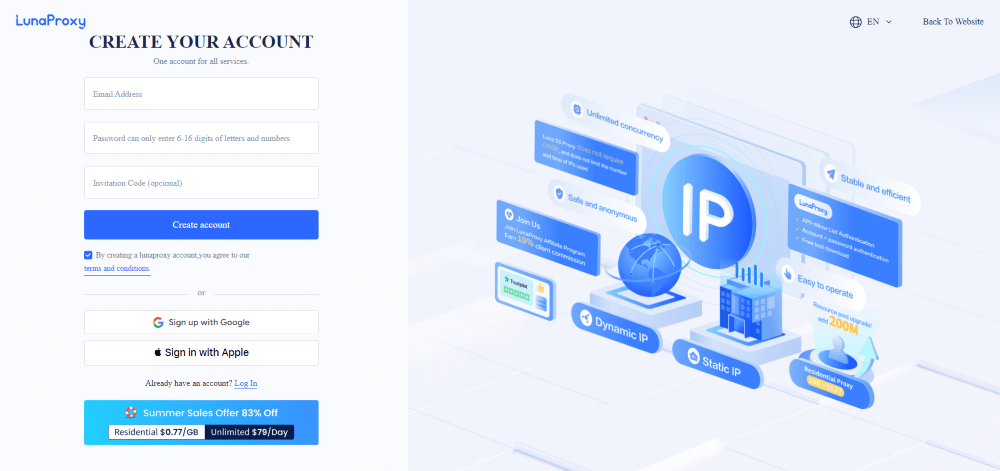
LunaProxy is a Hong Kong-based proxy provider that entered the market in 2022. It belongs to a wave of low-cost providers that became visible between 2022 and 2024, especially among buyers looking for residential proxies without enterprise-level pricing.
The reason LunaProxy gets attention is simple: it knows how to appeal to budget-conscious users. It offers:
- low-cost residential proxy plans
- unlimited residential access options
- datacenter and ISP proxies
- a desktop proxy manager app
- multiple payment methods, including crypto
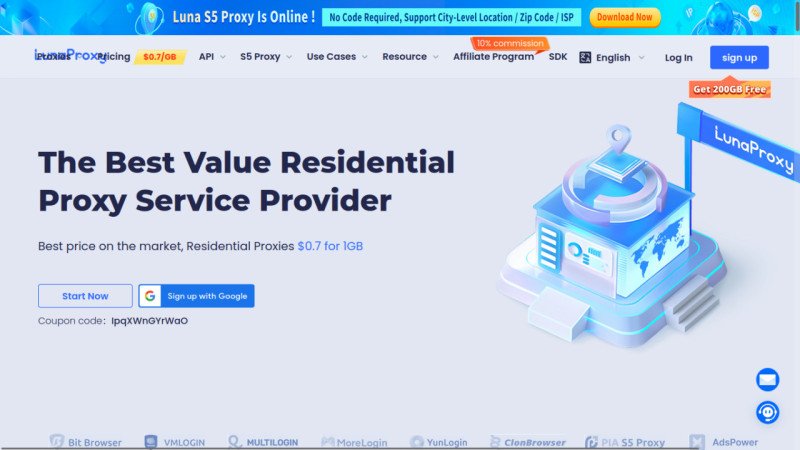
For many users, that combination feels attractive. Other providers may have cleaner branding or stronger reputations, but LunaProxy competes on accessibility and pricing. If you are looking at the market from a pure cost-per-GB perspective, it is easy to see why LunaProxy enters the shortlist quickly.
The problem is that the proxy market is not one where “cheap” automatically equals “smart.” Providers can underprice services for several reasons, and not all of those reasons are reassuring.
LunaProxy’s Main Product Lines
LunaProxy offers three main proxy categories:
- Residential proxies in metered and unlimited formats
- Datacenter proxies for dedicated use
- ISP proxies in dedicated and pool-based forms
The residential products are the core of the offer and the main reason most buyers consider the service. These are also the products most relevant for scraping, automation, sneaker tasks, account management, and web data collection.
Metered residential proxies
The traffic-based residential product is aimed at users who want broad IP variety and more controlled billing. This type of plan is generally more suitable for structured scraping workloads because you pay based on bandwidth and can estimate costs more predictably if you know your usage pattern.
The metered product offers targeting by country, state, city, and in some cases ISP or ZIP-related parameters through the provider’s tools. Sessions can rotate with every request or remain sticky for a chosen period.
Unlimited residential proxies
The unlimited residential plan is what makes LunaProxy unusual. Unlimited access residential plans are far less common than they once were, largely because they carry higher abuse risk and can create quality issues if not controlled carefully.
For high-volume users, however, the appeal is obvious. If your workflow burns through bandwidth quickly, paying a flat rate for access can make more sense than watching every gigabyte. LunaProxy claims to make this practical by assigning dedicated server resources to customers using the unlimited offer.
That sounds useful on paper, though it also raises the stakes: unlimited plans are only compelling if the network quality holds up under pressure.
The Best Part of LunaProxy: Price and Feature Value
The biggest reason people consider LunaProxy is not mystery. It is price.
LunaProxy’s residential proxy pricing undercuts a large share of established competitors, especially in the metered category. Up to fairly high usage volumes, the price-per-GB can look several times cheaper than many mainstream providers. For startups, solo builders, and small scraping teams, that difference is hard to ignore.
But price is only one part of the value equation. LunaProxy also adds a few extras that improve its practical appeal:
- Traffic rollover: if you renew in time, unused bandwidth can carry forward
- Optional proxy manager: a free desktop application for working more directly with IPs
- No traffic or thread limits on unlimited plans: useful for heavy-use cases
- Flexible session control: rotate every request or hold sessions for 1–90 minutes
This is why LunaProxy feels strong as a “value” product. It is not just low-cost. It is low-cost with a set of features that can feel unusually generous.
If your buying criteria begin with budget and throughput, LunaProxy immediately becomes easier to justify.

Where the Concerns Begin
Low prices in the proxy industry often come with trade-offs, and LunaProxy is no exception.
One of the biggest issues is business trust. The company has limited public transparency around ownership, KYC procedures, and usage practices. That by itself does not automatically make a provider unusable, but it does make it harder to categorize the business as fully reputable.
Concerns deepen when discussions around possible proxy sourcing, network reselling, and broader industry behavior enter the picture. If you are using proxies for sensitive business workflows, enterprise compliance, or long-term client-facing products, the provider’s reputation matters almost as much as the technical specs.
This is where LunaProxy becomes difficult to recommend without qualification. A low-cost provider can still be useful for experimentation, short-term scraping, or budget-sensitive testing. It becomes a harder sell when trust, auditability, and operational assurance are priorities.
Performance: Good Enough, But Not a Leader
Performance is where LunaProxy looks acceptable rather than exceptional.
Its residential network appears reasonably large and predominantly residential in composition, with especially notable strength in certain regions such as Brazil and India. Country-specific pools performed better than the broad global pool, which is common across many providers.
That said, LunaProxy does not appear to lead the market in speed or success rate. Compared with stronger premium alternatives, response times can be slower and reliability slightly weaker. For many basic workloads, that may not be a deal-breaker. For more demanding scraping operations, it can become more noticeable.
In practice, this means LunaProxy may be “good enough” if your workflow prioritizes cost efficiency over peak performance. It may be less attractive if you need the fastest possible response times, the highest scraping success rates, or very stable infrastructure for intensive automated tasks.
User Experience: Better Than Expected, Still Uneven
LunaProxy’s user experience is a mixed picture.
On the positive side, the provider includes a dashboard with multiple language options, setup widgets, invoice downloads, usage tracking, and plan management. There is also a downloadable manager app for Windows and Linux that adds more direct proxy control.
The proxy manager is particularly notable. It resembles a style of proxy management interface that some users may find very practical for careful IP selection and account-oriented tasks. Instead of forcing you to work only through gateways, it gives you another way to manage access through locally bound ports and selected IPs.
That is a real value add.
However, the UX is not consistently polished. The dashboard can be awkward on smaller screens, and parts of the experience feel utilitarian rather than refined. Registration quirks—such as restrictive password rules—also reduce confidence rather than building it.
The provider’s documentation is adequate, though not especially elegant. It covers a fair amount, but some integrations remain underexplained, especially for developers who want richer examples with scraping libraries and automation stacks.
Support Quality Is a Weak Point
Support matters more in proxies than many buyers expect. When something breaks, sessions fail, locations mismatch, or traffic drains unexpectedly, you need clear answers quickly.
This is one of LunaProxy’s weaker areas.
The provider advertises always-on support, but in practice the first line of contact appears to rely heavily on chat automation. That can work for simple pre-defined questions, but it becomes frustrating when the issue is specific or technical. Email support exists, but response times are not ideal compared with stronger competitors.
If you are self-sufficient and comfortable troubleshooting, you may tolerate this. If responsive support is part of your buying criteria, LunaProxy looks less attractive.
Who LunaProxy Is Best For
LunaProxy makes the most sense for users who care strongly about price and can tolerate some ambiguity around polish, reputation, and support.
It may be a fit for:
- budget-conscious scraping teams
- solo operators testing automation workflows
- users who want access to cheap residential traffic
- buyers who specifically value unlimited residential plans
- technical users comfortable with uneven UX and self-troubleshooting
It may be a poor fit for:
- enterprise teams with compliance concerns
- buyers who require strong business transparency
- users who need premium support responsiveness
- projects where the cleanest reputation matters as much as performance

LunaProxy vs Premium Proxy Providers
Compared with better-known premium brands, LunaProxy is not really competing on trust or best-in-class infrastructure. It competes on value.
If you compare it with more established names in the proxy space, the trade-off becomes clear:
| Factor | LunaProxy | Premium Alternatives |
|---|---|---|
| Price | Very low | Higher |
| Support | Weaker | Usually stronger |
| Business transparency | Limited | Generally better |
| Feature value | Strong for the price | Often more polished |
| Performance | Decent | Often stronger |
This is why LunaProxy is easier to justify as a tactical tool than as a long-term, fully trusted infrastructure partner.
FAQ
Is LunaProxy cheap?
Yes. Price is one of its biggest strengths, especially for metered residential proxies and users comparing cost per GB.
Does LunaProxy offer unlimited residential proxies?
Yes. That is one of its standout differentiators, though unlimited products also raise more quality and abuse-related concerns than metered plans.
Is LunaProxy good for scraping?
It can work for scraping, especially if budget matters more than top-tier performance. However, it may not match the strongest premium providers in speed or reliability.
Is LunaProxy trustworthy?
This is where caution is reasonable. The provider offers attractive pricing and features, but questions around transparency and business practices make it harder to describe as fully reputable.
Who should try LunaProxy first?
Budget-conscious technical users, small scraping teams, and buyers testing lower-cost residential options may find it worth evaluating.
Conclusion
LunaProxy is not an easy provider to summarize in one word. It is not “bad,” and it is not “safe by default.” It is one of those tools that can look extremely attractive from a pricing and feature perspective, while still carrying enough questions to justify caution.
The strongest case for LunaProxy is value. The weakest case is trust.
Trying LunaProxy as a low-cost proxy option may make sense if your priority is affordable access, flexible residential plans, and useful extras like a proxy manager—but you should go in with clear expectations about support, transparency, and performance trade-offs rather than assuming cheap access automatically means low-risk infrastructure.


